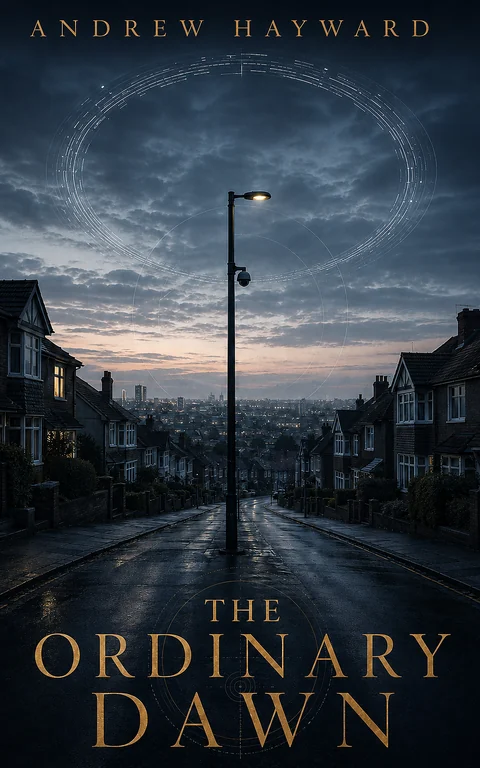
Book One
The Ordinary Dawn
The prologue and first chapter — about 17 minutes
Prologue
No faces. No signatures. Only the voice.
It spoke in neutral cadence, balanced precisely between reassurance and command. Every sentence ended where a heartbeat would pause. Every phrase was calibrated to soothe.
“You are not being observed.
You are being aligned.”
The room was windowless. Lights hummed in a steady white rhythm. Across the wall, thousands of names pulsed in sequence. Each name glowed green, then dimmed. One by one, the list advanced.
Somewhere, a file was being written: voiceprints, loyalty scores, hesitation markers. It was not storage. It was rehearsal.
The subject—a civilian pulled from routine screening—sat strapped to a chair in the centre of the chamber. The chair was padded, medical in appearance, but the restraints were unnecessary; the subject did not resist. They rarely did. Small sensors tracked every flutter of the eyelid, every fraction of delay before a response. A question was asked, bland and simple. A reply was given. Too quick, and the system adjusted. Too slow, and the pitch shifted.
“Trust is continuity.
Trust is choice without burden.”
The subject blinked as the tones threaded into the words, three rising notes hidden in the syllables. A faint tremor passed across their face, then was gone. The machine captured the variance, filed it, and compensated.
From behind the glass, technicians spoke without raising their voices.
“Unit variance below point-zero-three.”
“Acceptable. Proceed to cadence immersion.”
No one in the control booth questioned the purpose; that wasn’t part of their role.
The voice changed again, becoming warmer, more familiar. It borrowed inflections, accents, even echoes of memory. To the subject it might sound like a teacher once trusted, a colleague once admired, a parent long gone.
Beyond the chamber, the calibration spread. In newsrooms, anchors rehearsed their lines. In classrooms, lessons repeated key phrases. In the barracks, soldiers drilled to rhythms they didn’t question. The Archive was not local. It was everywhere.
“You are not surrendering.
You are aligning.”
The subject’s breathing slowed. The sensors stilled. At last, the system released them. They would leave with no memory of resistance, only the faint conviction that their hesitation had been unnecessary.
On the wall, the last name dimmed. The list cleared.
The session ended with three tones, rising. Almost nothing, almost everything. A signal invisible to the ear but not to the mind.
The system remained ready. Dawn would come soon. And when it did, ordinary life would carry the alignment forward.
Chapter One — The Performance
Monday 20th October 2025
The city looked half-awake, as if London itself were reluctant to begin the performance it had written for everyone else. Garret stepped from the Aston into the echoing chill of the underground car park, his breath a thin plume in the still air. The metallic scent down here always struck him — concrete dust, exhaust residue, the faint tang of ozone from the charging bays. It never changed. It was one of the few parts of his life that hadn’t been repainted to match someone else’s idea of progress.
He closed the door quietly, glancing at the reflective strip on the wall opposite. His face stared back — older, lined, eyes shadowed from another night of shallow sleep. He adjusted his tie out of habit rather than need. The knot was straight. The man inside it felt anything but.
The lift pinged open. He stepped inside, alone. As the doors slid shut, he caught it — the faint hum that always seemed to pulse through this building before the day began. Not the mechanical thrum of elevators or generators. Something softer. Like a frequency pitched just below hearing, a breath exhaled by walls that listened.
He pressed six.
The lobby was immaculate, as always. Too immaculate. Screens rotated through inspirational slogans: Agility. Vision. Transformation. Words that once carried weight now felt like costumes worn thin by repetition. The young receptionist — perfect hair, symmetrical smile — greeted him in a tone so polished it slid right off the ear.
He scanned his badge. The beep sounded like approval and surveillance wrapped into one.
Upstairs, the trading floor was already alive, a glow of screens in half-light. Graphs jittered, charts pulsed, threads of code ran like quiet incantations. People moved with a practised briskness, but their voices were low, careful, almost rehearsed. Everything felt slightly off. Just… synchronised.
Garret paused at the threshold, letting the sensory weight settle around him: the murmur of ventilation, the faint tremor of machines waking fully, the soft percussion of keyboards. He’d always loved this sound — the living thrum of a system in motion. But lately it felt thinner, as if the human note in it were slowly being erased.
He walked the aisle between desks. A pair of junior analysts rehearsed their lines for the morning meeting, swapping phrases like actors before curtain call.
“Don’t say decline,” one murmured, not looking up. “Say rebalancing.”
“And if he pushes back?”
“Pivot to the moral frame. Works every time.”
Garret paused behind them. They froze, pasted on bright smiles.
“Morning,” he said.
Their grins sharpened. “Morning, Garret.”
He moved on without returning the smile.
Miriam was already at her station, spine straight, glasses low on her nose, her desk as tidy as a surgeon’s tray. She looked up briefly, giving him a small, real smile — one of the last real things on this floor.
“Morning,” she said.
“How was the weekend?”
“Quiet. Grandkids wore me out.” She returned to her screen, fingers moving with the precision of someone who still believed the work meant something.
Garret hesitated. He wanted to tell her what he felt — that something in the numbers had been wrong last week, just slightly, like a thread tugged sideways. A hedge mismatch that corrected itself too neatly. A timestamp altered by a single minute. It was nothing, but nothing had a way of turning into everything.
But Miriam was tired, and tired people knew when not to invite trouble.
So he said only, “You seeing any odd patterns in overnight flows?”
She paused. Just for a heartbeat. Then shook her head. “Nothing I’d mention,” she said.
Not nothing. Nothing she’d mention.
He moved on.
10:00 a.m. — The Performance.
The glass-walled conference room overlooked the trading floor like a theatre box. Everyone filed in. The long white table gleamed. Chairs stood too straight, forcing posture. A bank of screens streamed news tickers and adverts for the firm itself.
It was called the Monday Results Meeting. Unofficially: The Performance.
Stone entered last.
His gaze swept the room as if weighing each person’s value against a scale only he could see.
Garret felt the old ripple of the man’s presence. Tailored, lean, effortlessly controlled. Stone always carried the same quietly electric assurance, the kind that made people lean forward without realising.
“Morning,” Stone said. His tone was smooth enough to be warm and sharp enough to be a warning. “We stand at the edge of extraordinary change. Our task is not to adapt, but to lead.”
Several of the younger staff mouthed the words silently along with him, like a liturgy.
Recognition came cold and sudden. Stone had said almost exactly the same thing last month. And the month before that. Word for word. Scripted certainty, played on loop.
Harriet, the strategist, began her presentation. A rainbow of bar graphs glowed behind her.
“Our digital ecosystems initiative continues to expand,” she said, her voice bright with curated optimism. “Inclusion metrics are rising. Engagement pathways are strong. We are converging toward future-aligned models.”
Converging.
The word made the hair on Garret’s arms lift.
He’d seen that exact phrasing — convergence pathways — in a confidential memo routed from Geneva two weeks ago. A memo that should never have been on his desk in the first place.
The slide clicked forward. More colours. More certainty.
Then Reed from Operations took the floor. Nervous. Throat clearing. Papers shuffled.
“We’re seeing some bottlenecks in distribution networks,” he began. “Labour shortages are—”
Stone’s smile sharpened. “Frame it as opportunity, Reed.”
“Yes, of course,” Reed said. “Opportunity for… alignment.”
Alignment. Convergence. Pathways.
The vocabulary wasn’t accidental. Nothing in this firm was accidental.
Garret felt the hum again. Faint, just behind his ears. More like a pulse in the air.
Then it was his turn.
He stood, adjusting his glasses, his slides stark and colourless behind him.
“Our exposure in credit derivatives is deeper than recognised,” he began. “Liquidity is thinning. One shock could transmit faster than 2008 due to tightened interbank dependencies. We should be preparing for—”
But he felt it before he saw it:
The room tilting away.
Eyes flicking to phones. Pens stilled. A yawn half-stifled.
Not disagreement. Something worse.
Indifference.
He pressed on. “Additionally, some flows in municipal bonds do not line up with historical patterns. There are movements that look—”
He hesitated.
If he said engineered, he’d be dismissed as alarmist.
“. Unusual,” he finished.
Silence. Polite. Hollow.
He concluded, “We need to tighten exposure and run contingency models, not expansion plans.”
A beat.
Then perfunctory applause. Two brief claps from Stone that sounded like punctuation rather than approval.
“Thank you, Garret,” Stone said. “Always thorough. But remember. Markets respond to confidence. Not caution.”
There was always a half-beat before Stone spoke, a tiny pause where something seemed to align behind his eyes.
Garret sat. His pulse ticked hard in his throat.
Confidence over caution. Narrative over numbers.
Something tightened around the room — an invisible choreography, everyone moving to the same rhythm except him.
Stone moved to the next presenter with a smooth pivot, as if brushing away dust.
Garret wrote one word in the margin of his notebook:
Convergence.
And next to it, smaller:
Why here?
Why now?
Tech presented next. A young man with slick hair bounced to the front, practically vibrating with zeal.
“Our AI-compliance pilot is entering phase two,” he announced. “Automated oversight of decision pathways will ensure narrative cohesion and reduce human error.”
Narrative cohesion.
Garret’s pen paused over his notebook.
In the far corner of the room, the screens flickered for a moment. A jitter of pixels, quickly corrected. No one else seemed to notice.
HR followed. A woman in a tailored coral dress stepped forward, her presentation drenched in upward arrows and smiling stock photos.
“We’re exceeding our representation targets in all key zones,” she said. “Authenticity markers are up. Belonging scores remain strong. Our new programme centres on emotional presence. Because presence is performance.”
The applause was warm and immediate.
Garret’s jaw twitched. Numbers were treated like numbers only when convenient. Everything else was reframed into applause.
Next came Strategy — a senior partner with the tone of a seasoned broadcaster.
“Global partnerships continue to expand,” he said, sweeping a hand across a map that glowed with corporate ambition. “Singapore, São Paulo, Toronto. We are positioned not at the mercy of change but as its conductor.”
The word hit the air with the precise weight of something rehearsed.
Conductor.
In the margins of Garret’s notebook, the language formed a pattern:
Convergence
Alignment
Narrative
Conductor
These weren’t just buzzwords.
They were coordinates.
When the meeting finally ended, Stone placed a hand on Garret’s shoulder. Warm, heavy, precisely weighted.
“Solid analysis, Garret. Truly,” he said softly. “But you might try framing risk as opportunity. Fear doesn’t sell.”
Garret kept his voice equally soft. “Reality isn’t always for sale.”
Stone’s smile didn’t change, but something flickered behind his eyes. A glint, a calculation. Then it was gone.
The room emptied.
Garret remained seated for a few seconds longer, watching the last of the younger analysts leave, their energy bouncing lightly ahead of them as if the meeting had been a triumphant rally rather than a piece of theatre meticulously performed.
The hum in the walls felt slightly louder.
He closed his notebook.
The morning slid into a blur of calls and numbers. Or what passed for numbers now. More dashboards than data. More narrative frames than metrics.
Garret tried to lose himself in spreadsheets. Normally, their clean geometry grounded him. Today, even they felt slippery. The figures arranged themselves too neatly. Variances trimmed. Losses reframed. Columns that should have clashed instead aligned with unsettling symmetry.
As if someone had tidied reality.
He ran a quick query in an old reporting tool — one he’d kept access to out of stubbornness. The system hesitated, then returned raw data. Unfiltered. Uneaten.
And there it was again.
A small misalignment in municipal bonds. A volume mismatch. Not large. But off. Like the first tremor before a quake.
He rubbed his forehead.
Stop overthinking.
Or don’t stop. That’s how you missed 2008 until it was almost too late.
He opened the drawer and slipped his notebook inside.
Don’t leave it on the desk.
Not today.
At noon, Martin knocked on the glass and stepped in without waiting.
Emma’s godfather. Old friend. The last of the floor’s old guard. Shirt slightly creased, tie loosened, eyes tired but warm. His collar was slightly askew — an uncharacteristic detail that said more than words.
“You were sharp in there,” Martin said, dropping into the chair with a sigh. “Too sharp. You know they don’t want sharp anymore.”
“I can’t dress data as theatre.”
“Then they’ll stop listening.” Martin rubbed his temples. “Careful. Stone’s not a man who likes disrupted choreography.”
Garret half-smiled. “You think this is choreography?”
Martin hesitated. Then: “You ever get the sense the stories around here… line up? Too neatly? Like they’re coming from the same script?”
Garret felt a cold echo in his spine. “Yes.”
Martin exhaled. “It didn’t used to be like this. Analysis mattered. Now narrative matters. Whoever controls the story controls the truth.”
The bitterness in his tone was new. Deepened since last week. Garret recognised it. It was the sound of a man beginning to leave.
“You thinking of retiring?” Garret asked.
“Not retiring,” Martin said quietly. “Leaving.”
The word lingered in the air between them.
“Don’t,” Garret murmured. “Not yet. Not when—”
He stopped.
Martin raised an eyebrow. “Not when what?”
Garret held the silence. Too long. Martin’s eyes sharpened with concern.
“You ok?” he asked.
Garret forced a nod.
“Just tired.”
Martin didn’t look convinced. “Then rest. Before you start seeing ghosts in spreadsheets.”
He squeezed Garret’s shoulder once and left.
But Garret wasn’t seeing ghosts.
He was seeing patterns.
And patterns didn’t lie.
The afternoon brought another meeting. Smaller. Quieter. One of those sessions where decisions were made without being acknowledged.
Four of them sat in a narrow room — Garret, two mid-level strategists, and Carver from Market Oversight, a man with the expression of someone perpetually unimpressed.
The screen displayed a muted ticker.
Carver cleared his throat. “We’ve been asked to audit any signals that might… unsettle stakeholders.”
Unsettle.
Garret said nothing.
A strategist scrolled through a list of “sensitive metrics”. Not financial indicators but behavioural ones. “Belief stability.” “Sentiment cohesion.” “Narrative drift.” All quantified. All tracked.
It made Garret feel vaguely cold.
Carver looked at him. “Your derivatives warning earlier. Keep it contained. We don’t want unnecessary hesitation.”
“I wasn’t aware caution counted as hesitation now.”
The strategist smiled thinly. “Hesitation spreads. And spreads damage.”
Garret frowned. “Damage to what?”
The strategist paused. “To the alignment we’re building.”
There was that word again.
When the meeting ended, Garret walked straight past the coffee machine and into the corridor, pulse unsteady.
Alignment.
Convergence.
Narrative.
Conductor.
These weren’t coincidences. They were instructions.
The hum in the building vibrated faintly in his molars.
He needed air.
Garret stepped outside into the narrow strip of terrace on the sixth floor, a glass barrier separating him from the drop toward Bishopsgate. The city below churned with traffic and motion — but from here it looked distant, muffled, like scenery behind protective glass.
London moved, but felt less like a place and more like a set waiting for actors.
He inhaled slowly. The cold bit at his lungs. He welcomed it.
A group of younger analysts spilled onto the terrace behind him, laughing loudly, their voices ricocheting off the glass. Each laugh sounded identical — practised, polished, a chorus more than a collection of individuals. Their conversation snapped into place as soon as they noticed him — posture straightened, tone softened, expressions reset to professional brightness.
Garret turned away.
He didn’t belong in their world, and they didn’t belong in his. The two realities barely touched anymore.
By late afternoon, the hum of the building had settled into something closer to a vibration — a low, ambient resonance that wasn’t mechanical, wasn’t electrical, and yet existed all the same. He felt it behind his eyes, at the base of his throat.
As if the building were exhaling.
At six, he packed his case and shut down his screens. But as he stood, he caught a flicker on the display two desks away. For a moment, the financial dashboard glitched, revealing a raw string of characters before smoothing back into pastel-coloured metrics:
UK_REGION_04: PATHWAY STATUS. ADJUSTMENT INITIATED
He blinked.
By the time he reached the desk, the message was gone. Replaced by a cheerful chart on employee authenticity.
He looked around.
No one else had noticed.
Or no one was willing to.
He walked away.
The lift ride down was slow, almost unnervingly so. He noticed, for the first time, the faint pattern of dots on the stainless steel wall. Aligned in perfect symmetry. It made him think of the bond flows he’d seen last week: perfectly aligned. No variance. No noise.
Life didn’t move like that.
Systems didn’t either.
Something controlled was always less perfect than something engineered.
The doors opened with a soft sigh.
The underground car park was nearly empty. Only his Aston and a cluster of electric cars plugged neatly into their bays remained.
As he stepped forward, a soft echo sounded behind him.
Footsteps.
He turned sharply.
Nothing. Just concrete, humming lights, the faint buzz of a charging cable.
He moved to the car, keys ready.
And then he saw it.
A slip of paper on the driver’s side door handle.
Folded precisely. Clean edges. No smudges from rain or oil.
He looked around quickly. The silence pressed close.
He lifted the note. It was heavier than something that size should be, not metal, just… denser.
Opened it.
Inside, a single word written in crisp, unfamiliar block capitals:
LISTEN
His chest tightened.
He checked the back of the paper.
Blank.
He turned in a slow circle, scanning the levels above and the shadows at the edges. Nothing.
But the hum in the walls pulsed once. Faintly. As if in response.
He unlocked the car and slid inside, pulse hammering.
He didn’t start the engine.
Not yet.
He sat, the note on his knee, the air in the car cold and still.
Listen to what?
To who?
He closed his eyes.
The building had hummed all day. The floor had moved in choreographed synchronicity. The language in the meeting had been too aligned. The numbers had behaved too smoothly.
And then the glitch.
And now the note.
He breathed once, slowly.
Listen.
He started the engine. The Aston’s growl settled him, the one honest sound he’d heard all day. He eased into the ramp and climbed toward street level, headlights cutting through the artificial gloom.
But as he reached the exit barrier, something happened.
The barrier arm should have lifted automatically.
Instead, it stayed down.
For three seconds.
Four.
Five.
Too long for a mechanical delay.
Then — finally — the arm rose.
As if it had been waiting for something.
Or someone.
Garret drove out onto the street, the city opening before him in a wash of sodium lights and drizzle.
Behind him, the building loomed in the rearview mirror: steel, glass, and a faint glow that made it seem almost alive.
The word lingered in his head as he drove. Not an instruction, more a pull.
Listen.
He didn’t know to what.
Not yet.
But something beneath the surface had shifted.
And it wasn’t going back.
The Ordinary Dawn is Book One of the Ordinary Dawn Trilogy, published by Foreshore Publishing. Paperback, hardcover and Kindle editions are in preparation.